Brooks and Gilmore present at UK’s 2026 Showcase of Undergraduate Scholars
Undergraduate researchers Matthew Brooks and Layla Gilmore presented their projects — on UK’s Webb–Funkhouser anthropological legacy and the First Rhode Island Regiment at Butts Hill Fort — at UK’s 2026 Showcase of Undergraduate Scholars.
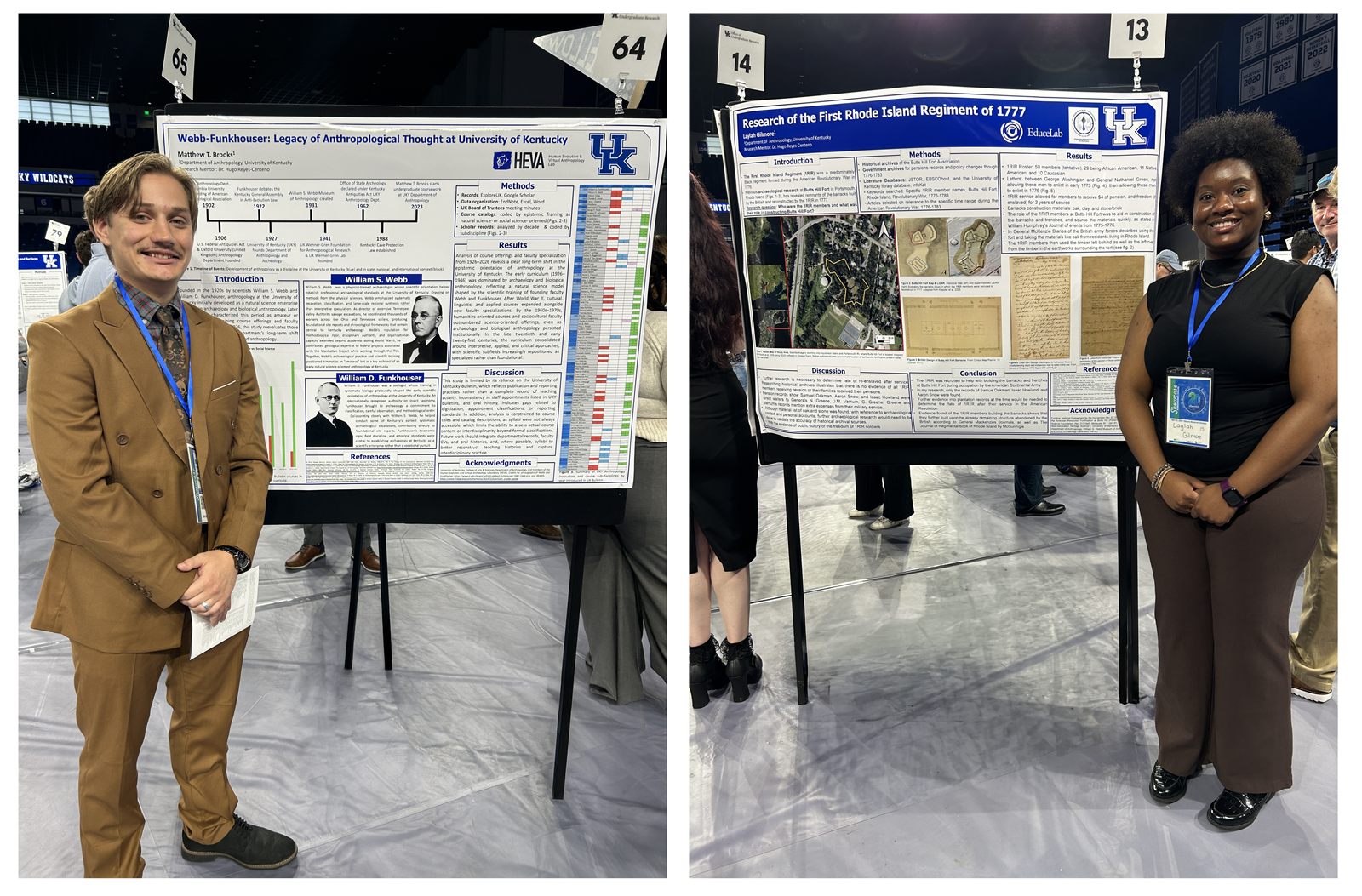
HEVA undergraduate researchers Matthew Brooks and Layla Gilmore presented their work at the University of Kentucky’s 2026 Showcase of Undergraduate Scholars on April 29, 2026.
Matthew Brooks — Webb-Funkhouser: Legacy of Anthropological Thought at the University of Kentucky
Anthropology at the University of Kentucky (UKY) emerged in the early twentieth century, when few dedicated anthropology departments existed in the United States. The Department of Anthropology and Archaeology at the UKY was founded on July 27th 1927, drawing from the formative work of co-founders William S. Webb, a physicist of the Manhattan Project, and William D. Funkhouser, a zoologist central to anti-evolution debates. This project aims to trace how Webb and Funkhouser established early standards of archaeological work in the Commonwealth, applying approaches of fieldwork, classification, and empirical evidence drawn from their respective, established scientific disciplines. Here, discussed is the early foundation of anthropology at the UKY and the successive generations of scholars who shaped, curated, and changed the department’s intellectual record with diverse methods, theories, and assumptions in the production of anthropological knowledge. Demonstrated through archival and published sources, such as university course bulletins and scholarly output, the project highlights both intellectual continuity and disruption. This study finds that early anthropology at the UKY was structured around a deliberate, science-oriented emphasis on archaeology and biological anthropology under Webb and Funkhouser, rather than the amateurism later attributed to them. Later sources demonstrate Anthropology shifting toward more reflexive and interpretive approaches. Analysis of course offerings and faculty specialization shows substantial continuity in training and methodology, alongside gradual reorientation toward cultural, applied, and linguistic approaches as the discipline became increasingly allied to the social sciences and less so to the natural sciences. Later narratives of professionalization reflect disciplinary politics and retrospective reinterpretation as much as substantive intellectual transformation. Written in recognition of the department’s centennial, this study is intended as a shared point of reflection on how the University of Kentucky has come to know its institutional past and the history of the Commonwealth.
Layla Gilmore — The First Rhode Island Regiment of 1777
The First Rhode Island Regiment (1RIR) was a predominantly Black regiment formed during the American Revolutionary War in 1776. Previous archaeological work at Butts Hill Fort in Portsmouth, Rhode Island, has revealed remnants of barracks originally constructed during British military occupation and later modified by 1RIR members during occupation by the Continental Army in 1777. The goal of this project is to better understand the roles the 1RIR played in constructing Butts Hill Fort, focusing on three soldiers, namely Isaac Howland, ‘Sampson’ or Samuel Oatman, and Aaron Snow. Evidence from historical archives, academic manuscripts, and archaeological research illustrates that these soldiers were recruited or volunteered for military service to escape slavery, with the promise of freedom and a pension following their service in fighting for American independence. Over the course of their 3-year service, the 1RIR primarily performed manual labor constructing new trenches, as well as cooking, cleaning, and military combat. Historical accounts from 1779 suggest that only a few of the 1RIR soldiers were free after their service. This project reflects on the journey that led 1RIR members to join the American Revolutionary War, as well as the events that have shaped their legacy today.