EduceLab launches Virtual Exhibition of Butts Hill Fort for America's 250th anniversary
A new interactive 2D & 3D exhibition brings the American Revolution fortification at Butts Hill (Portsmouth, Rhode Island) to life — layering historic maps, LiDAR, and geophysical survey with artifacts and reenactors.
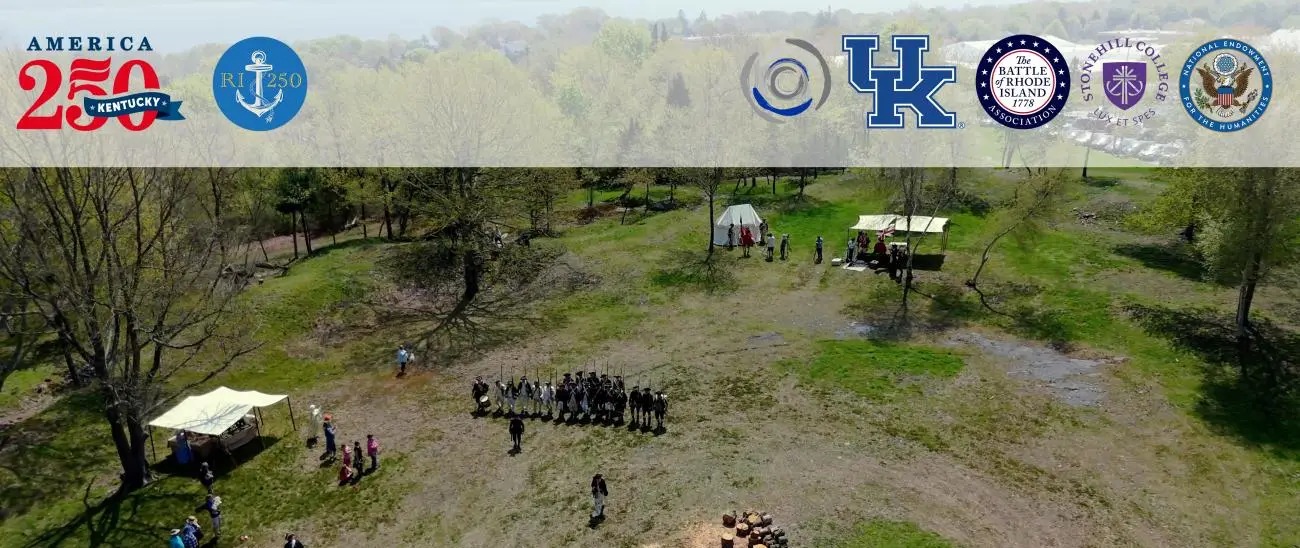 Explore the Virtual Exhibit →Interactive 2D & 3D collections — historic maps, LiDAR, artifacts, and reenactors
In celebration of the nation’s semiquincentennial — America’s 250th anniversary — EduceLab has launched a Virtual Exhibition of the American Revolution fortification at Butts Hill (Portsmouth, Rhode Island), where HEVA members have conducted non-destructive archaeological fieldwork since 2024. The exhibit presents a curated 2D and 3D collection of digitized materials: historical maps showing the fort’s dynamic re-configuration under alternating American and British occupation, 20th- and 21st-century aerial imagery, and recent LiDAR, magnetometry, and ground-penetrating radar (GPR) data — viewable superimposed on modern maps and satellite imagery in 2D, and on an immersive 3D LiDAR model alongside artifacts and reenactors brought together by the Battle of Rhode Island Association and the Artillery Company of Newport.
The project team
The project is directed by HEVA Lab director Dr. Hugo Reyes-Centeno, with co-director Alexandra Uhl (Stonehill College). HEVA member Alexander Wise designed and built the interactive exhibit website as Website Coordinator and Content Manager, and HEVA member Samuel Koontz served as Archaeological Field Director and 3D Digital Assets Coordinator. Additional University of Kentucky contributors include Bhushan Chitre, George Crothers, James Keppeler, Philip Mink, Dr. Seth Parker, and Marcus Rodriguez, alongside collaborators Col. Paul Murphy, Jim Stearns, and Joe Studlick of the Battle of Rhode Island Association. The exhibit was inspired by the team’s remote-sensing research at the fort (Keppeler et al. 2025, Heritage).
Funding & support
The project was funded by the U.S. National Endowment for the Humanities (Celebrate America! Chairman’s Grant in Honor of America’s 250th Anniversary, Award No. ZZ-309418-25), the van Beuren Charitable Foundation, and the Battle of Rhode Island Association, with additional support from the U.S. National Science Foundation (Award No. 2131940) and the University of Kentucky.