HEVA members survey Lexington's African Cemetery No. 2 with GPR and magnetometry
HEVA members Samuel Koontz, Marcus Rodriguez, and James Keppeler joined a ground-penetrating radar and magnetometry survey of African Cemetery No. 2 in Lexington — a National Register burial ground where most graves are unmarked.
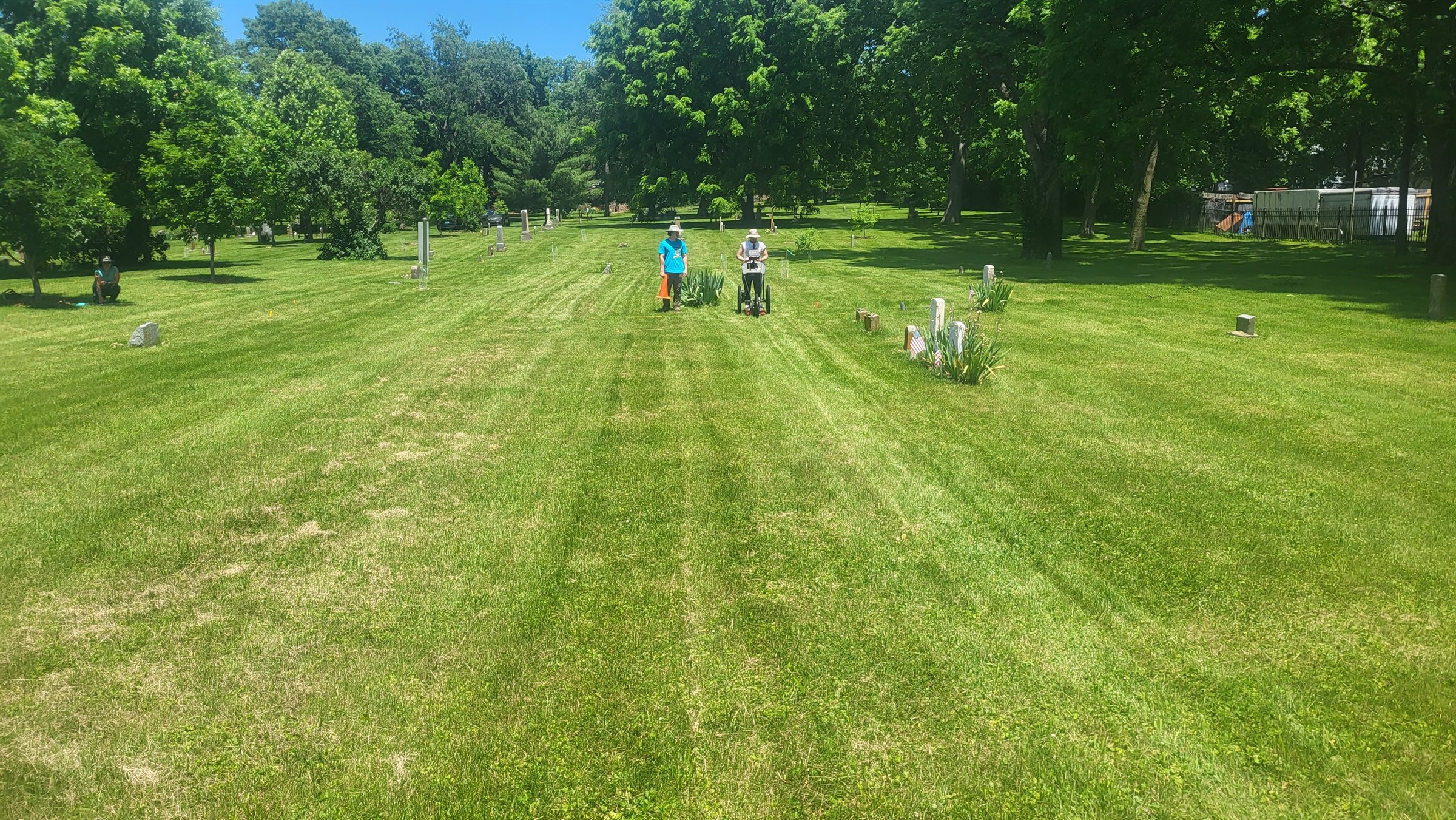
In May 2023, HEVA members contributed to geophysical survey at African Cemetery No. 2 at 419 East Seventh Street in Lexington — the Fayette County half of “Documenting Historic African American Cemeteries with New Heritage Sciences Methods”, led by Dr. Elena Sesma with Dr. George Crothers as co-investigator and funded by a Wenner-Gren Foundation Post-PhD Research Grant.
Samuel Koontz, Marcus Rodriguez, and James Keppeler worked the ground-penetrating radar alongside Crothers and Sesma, with magnetometry also employed across the burial ground. The project’s aim was methodological: to establish which techniques best document unmarked or poorly marked burial grounds, and at what scale of detail. Across the two cemeteries it paired these ground-based methods with aerial orthomosaic photography, LiDAR, and spectral imagery.
Established in 1869 by the Colored Peoples Union Benevolent Society No. 2, African Cemetery No. 2 is the earliest recorded Lexington cemetery organized, owned, and managed by African Americans. It carries a Kentucky Historical Society highway marker dedicated in 2003, was added to the National Register of Historic Places in 2004, and is cared for today by African Cemetery No. 2, Inc. Its documented history records more than 5,000 burials with fewer than 600 marked by surviving headstones, among them 112 United States Colored Troops, many of whom trained at nearby Camp Nelson. Further detail on those interred is collected in UK Libraries’ Notable Kentucky African Americans Database.